Project overview
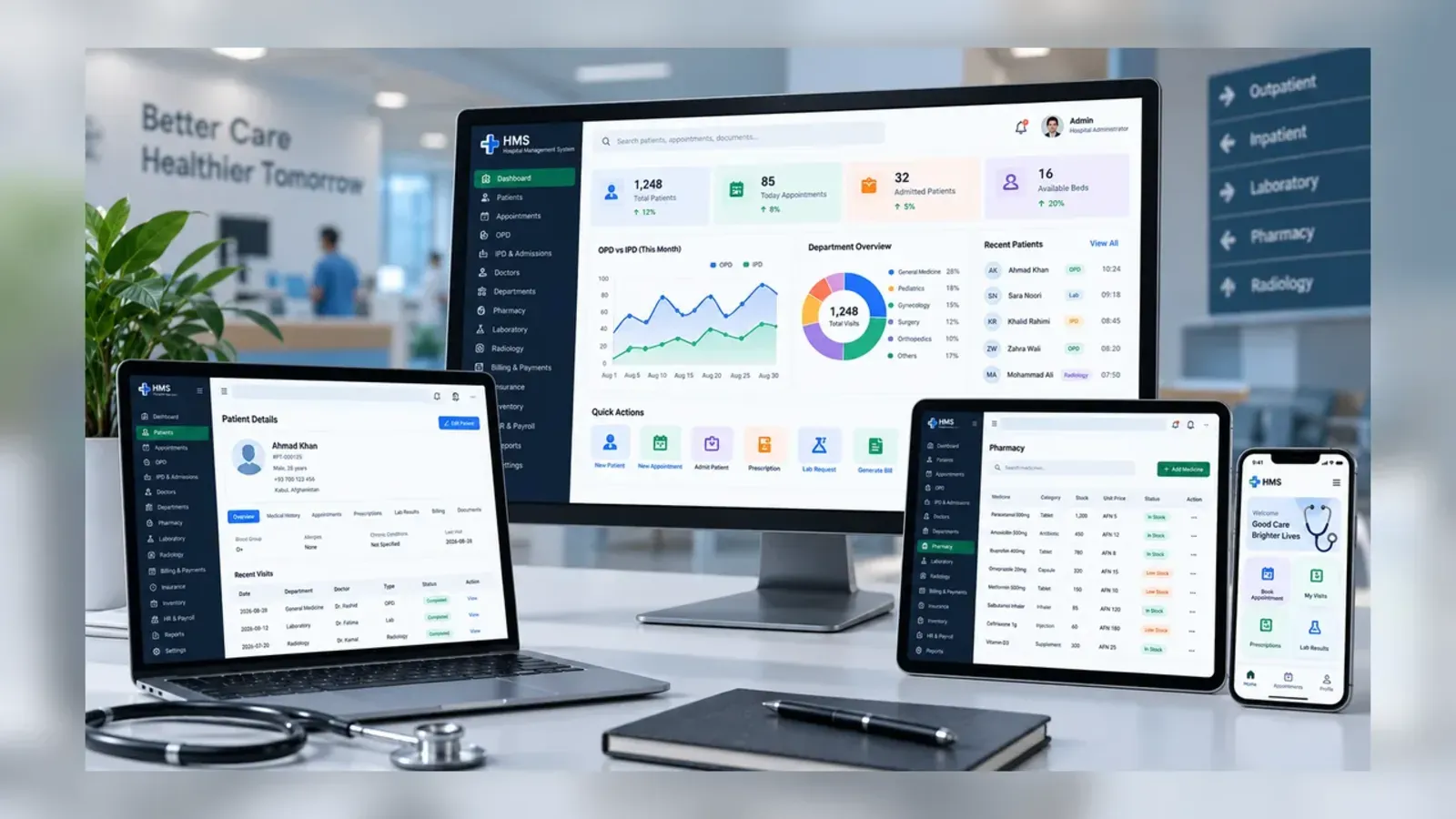
This Enterprise Hospital Management System is designed as a complete digital platform for hospitals and healthcare organizations that need to manage complex clinical, administrative, and financial operations from one system. The platform can include patient registration, appointments, doctors, departments, OPD and IPD workflows, admissions, wards and beds, prescriptions, pharmacy, laboratory, radiology, billing, payments, insurance, inventory, suppliers, HR, payroll, ambulance services, reports, notifications, audit logs, roles and permissions, backups, and multi-branch support. The system is structured so different departments can work independently while still sharing the information they need. Authorized management can monitor hospital activity through dashboards, reports, and operational summaries.
Challenge
Large hospitals often depend on many separate processes for patient records, appointments, laboratory work, pharmacy, billing, inventory, staff management, and financial operations. When these processes are disconnected, information can be duplicated, reports become difficult to prepare, departments may not have timely access to important data, and management has limited visibility over the organization. The challenge is to connect these departments while maintaining privacy, clear permissions, reliable workflows, and a system that remains easy to use.
Solution
The proposed solution is a centralized hospital management platform with dedicated modules for clinical care, administration, finance, inventory, and workforce operations. Patients can move through registration, consultation, laboratory, pharmacy, admission, billing, and discharge workflows while their authorized information remains connected. Doctors and clinical staff can access relevant patient information, while pharmacy and inventory modules track medicines and medical supplies. Billing, payments, insurance, and financial records can be managed from the same platform. Role-based permissions restrict access according to each employee's responsibilities, while audit logs improve accountability. Dashboards and reports provide management with visibility into patients, departments, revenue, expenses, inventory, workforce, and overall hospital activity. The architecture can also support multiple branches, integrations, notifications, backups, and future expansion.
Result
This case-study concept demonstrates how a hospital can replace fragmented manual and disconnected digital processes with one structured enterprise platform. The proposed system provides a foundation for faster workflows, better information sharing, stronger operational control, improved reporting, clearer accountability, and scalable management across multiple hospital departments and locations.